

Work/Working... Go/Going... do/doing...
Work/Go/Be etc (infinitive): will/can/must + infinitive Anna will be here soon. ° Shall I open the window? ° I might phone you later. ° May I sit here? ° I can't meet you tomorrow. ° Could you pass the salt, please?

to... (I want to do) and -ing (I enjoy doing)
Verb + to (I want to do) - (to work / to be etc): What do you want to do this evening? ° It's not very late. We don't need to go home yet. ° Tina has decided to sell her car. ° You forgot to switch off the light when you went out.

I want you to... I told you to...
I want you to The woman wants to go. The man doesn't want the woman to go. He wants her to stay. I want you to be happy. (not I want that you are happy) ° They didn't want anybody to know their secret.

I went to the shop to...
Paula wanted a newspaper, so she went to the shop. ° Why did she go to the shop? To get a newspaper. ° She went to the shop to get a newspaper. to ... (to get / to see etc.) tells us why a person does something:

go to... go on... go for... going
go to ... (go to work / go to London / go to a concert etc.) ° What time do you usually go to work? ° I'm going to China next week. ° Sophie didn't want to go to the concert. ° Where's Tom? He's gone to bed. ° I went to the dentist yesterday.

How to use get
I got an email from Sam this morning. (= receive) ° I like your sweater. Where did you get it? (= buy) ° It's hard to get a job at the moment? (= find) ° Is Lisa here? Yes, I'll get her for you. also get a bus / a train / a taxi (= take a bus / train etc):

How to use do and make
Do is a general word for actions: ° What are you doing this evening? (not What are you making?) ° Shall I open the window? No, it's OK. I'll do it. ° Rachel's job is very boring. She does the same thing every day. ° I did a lot of things yesterday.
How to use have
I have (something) or I've got (something) = it is mine: ° I have a new car. or I've got a new car. ° Sue has long hair. or Sue has got long hair. ° Do they have any children? or Have they got any children?

I/me he/him / they/them etc
I don't want this book. You can have it. O I don't want these books. You can have them. O Kate never drinks milk. She doesn't like it. O I never go to parties. I don't like them. We use me/her/them etc. (object) after a preposition (for/to/with etc.):

my/his / their/your etc
its Oxford is famous for its university. it's (= it is) I like Oxford. It's a nice place. (= It is a nice place.) Make the sentences in the same way. 1. I'm going to wash my hands. 2. She's going to wash her hands.

Whose is this? It's mine-yours-hers etc
We use my/your etc. + noun (my hands / your book etc.): - My hands are cold. - Helen gave me her umbrella. - Is this your book? - It's their problem, not our problem.

I / me / my / mine
Do you know that man? Yes, I know him, but I can't remember his name - She was very pleased because we invited her to stay with us at our house. - A: Where are the children? Have you seen them? B: Yes, they are playing with their friends in the park.

myself - yourself - themselves etc.
I looked at myself in the mirror. - He cut himself with a knife. - She fell off her bike, but she didn't hurt herself, - Please help yourself. (one person) - Please help yourselves. (two or more people) - We had a good holiday. We enjoyed ourselves.

Kate's camera / my brother's car etc
We normally use -'s for people: - I stayed at my sister's house. (not the house of my sister) - Have you met Mr Black's wife? (not the wife of Mr Black) - Are you going to James's party? - Paul is a man's name. Paula is a woman's name.
How to use a and an
one thing or person: O Rachel works in a bank. (not in bank) O Can I ask a question? (not ask question) O I don't have a job at the moment. O There's a woman at the bus stop.

train(s) bus(es) (singular and plural)
Do you wear glasses? O Where are the scissors? I need them. You can also say a pair of scissors / a pair of trousers / a pair of pyjamas etc.: O I need a new pair of jeans. or I need some new jeans. (not a new jeans)

a bottle / some water (countable / uncountable 1)
A noun can be countable or uncountable: Countable nouns can be singular (= one) or plural (= two or many): O I've got a car. O New cars are very expensive. O There aren't many cars in the car park.

a cake / some cake / some cakes (countable / uncountable 2)
a/an + singular countable nouns (car/apple/shoe etc.): O I need a new car. O Would you like an apple? some + plural countable nouns (cars/apples/shoes etc.): O I need some new shoes.

A / AN / THE
There are three windows here a window = window 1 or 2 or 3. There is only one window here - the window. I've got a car. (there are many cars and I've got one) - Can I ask a question? (there are many questions - can I ask one?)
How to use The
We use the when it is clear which thing or person we mean: - What is the name of this street? (there is only one name) - Who is the best player in your team? (there is only one best player) - Can you tell me the time, please? (= the time now)

go to work - go home - go to the cinema
(go) to work. (be) at work, start work, finish work: - Bye! I'm going to work now. (not to the work) - I finish work at 5 o'clock every day. (go) to school, (be) at school, start school, leave school etc.

I like music - I hate exams
do not use the for general ideas: - I like music, especially classical music. (not the music... the classical music) - We don't eat meat very often. (not the meat) - Life is not possible without water. (not The life ... the water)

The... (names of places)
In general we do not use the with names of places: - France is a very large country. (not the France) - Cairo is the capital of Egypt. - Corsica is an island in the Mediterranean.

this / That / these / those
We use this/that/these/those with a noun (this picture / those girls etc.) Or without a noun. With a noun: - This hotel is expensive, but it's very nice. - Who's that girl? I don't know.

How to use one/ones
I need a pen. Do you have one? (one = a pen): - A: Is there a bank near here? B: Yes, there's one at the end of this street. (one = a bank): Which one? = Which hat? one = hat/car/girl etc .
How to use some and any
Use some in positive sentences: -I’m going to buy some clothes. -There's some milk in the fridge. -We made some mistakes. Use any in negative sentences:

How to use not + any no none
The car park is empty. There aren't any cars in the car park. There are no cars How many cars are there in the car park? None. not (-n't) + any: - There aren't any cars in the car park. - Tracey and Jack don't have any children.

not + anybody/anyone/anything nobody/no-one/nothing
not + anybody/anyone/nobody/no-one (for people) - There's anybody in the room. - There's nobody in the room. - A: Who is in the room? B: Nobody / no-one.
somebody/anything/nowhere etc
Somebody (or someone) has broken the window. Somebody/someone = a person, but we don't know who. - She has got something in her mouth. Something = a thing, but we don't know what. - Tom lives somewhere near London. Somewhere = in/to a place, but we don't know where.

how to use every and all
We use every + singular noun (every house /every country etc): - Sarah has been to every country in Europe. - Every summer we have a holiday by the sea. - She looks different every time I see here.

all - most - some - any - no/none
children/money/books etc. (in general): - Children like playing. (= children in general) - Money isn't everything. (= money in general) - I enjoy reading books. - Everybody needs friends.

both - either - neither
We use both/either/neither to talk about two things or people: Would you like tea or coffee? You can have either. (either = tea or coffee). - A: Do you want to go to the cinema or theater? B: Neither. I want to stay at home. neither = not the cinema or the theater.

a lot - much - many
We use much + uncountable noun (much food / much money etc.): - Did you buy much food? - We don't have much luggage. - How much money do you want?

How to uuse (a) little - (a) few
a little = some but not much - She didn't eat anything, but she drank a little water. - I speak a little Spanish. (= some Spanish but not much) - A: Can you speak Spanish? B: A little. a few = some but not many
old - nice - interesting etc (adjectives)
The adjective is before the noun:. - They live in a modern house (not a house modern) - Have you met any famous people? (not people famous) The ending of an adjective is always the same:
quickly - badly - suddenly etc. (adverbs)
Adverbs tell you know something happens or how somebody does something: - The train stopped suddenly. - I opened the door slowly. - Please listen carefully. - I understand you perfectly.

old/older - expensive/more expensive
Older/ heavier / more expensive are comparative forms. The comparative is -er (older) or more... (more expensive). - Rome is old, but Athens is older. (not more old) . - Is it cheaper to go by car or by train? (not more cheap).

old then - more expensive than
We use than after comparatives (older than ... / more expensive than ... etc.): - Athens is older than Rome. - Are oranges more expensive than bananas? - It's easier to take a taxi than to take the bus.

how to use not as ... as
- Rome is not as old as Athens. (= Athens is older). - The Grand Hotel isn't as expensive as the Europa. (= the Europa is more expensive). - I don't play tennis as often as you. (= you play more often).
how to use enough
- She isn't going to take a taxi. She hasn't got enough money. - He can't reach the shelf. He isn't tall enough. enough + noun (enough money / enough people etc.): - A: Is there enough milk in your coffee?

how to use too
too + adjective / adverb (too big / too hard etc): - Can you turn the radio down? It's too loud. (= louder than I want). - I can't work. I'm too tired. - I think you work too hard.

still/yet/already etc
still = something is the same as before: - I had a lot to eat, but I'm still hungry. (= I was hungry before, and I'm hungry now). - Did you sell your car? No, I've still got it. - Do you still live in Barcelona? No, I live in Madrid now.
how to use when...
We write a comma (,) if When ... is at the beginning: - When you're tired, don't drive. - Don't drive when you're tired. - Helen was 25 when she got married. - When Helen got married, she was 25.

if we go... if you see... etc
If can be at the beginning of a sentence or in the middle: In conversation, we often use the if-part of the sentence alone: - Are you going to the concert? Yes, if I can get a ticket. If you see Ann tomorrow ... etc:

if i had... if we went... etc
Dan likes fast cars, but he doesn't have one. He doesn't have enough money. If he had the money, he would buy a fast car. Usually had is past, but in this sentence had is not past. If he had the money = if he had the money now (but he doesn't have it).

a person who... a thing that/which (relative clauses 1)
Do not use which for people: - Do you remember the woman who was playing the piano at the party? (not the woman which). Make sentences A… is a person who… 1. A thief is a person who steals things.

the people we went - the hotel you stayed at (relative clauses 2)
You can say: - The bag that he is carrying… or the bag that is carrying… .(with or without that). - The money that Kate won? or ... the money Kate won?.. You do not need that/who/which when it is the object:

at 8 o'clock - on Monday - in April
at the weekend - at night - at Christmas - at the end of - at the moment: - Are you going away at the weekend? - I can't sleep at night. - Where will you be at Christmas? (but on Christmas Day). - I’m going on holiday at the end of October.
from - to - until - since - for
from... to: - We lived in Japan from 2003 to 2010. - I work from Monday to Friday. You can also say from ... until ... : - We lived in Japan from 2003 until 2010.
before - after - during - while
during while and for: We use during + noun (during the film). We use while + verb (while I'm reading): - We didn't speak during the meal. but We didn't speak while we were eating (not during we were eating):

in - at - on - (places 1)
- Where's David? In the kitchen. / In the garden. / In London. - What's in that box / in that bag / in that cupboard? - Rachel works in a shop / in a bank / in a factory. - I went for a swim in the river / in the pool / in the sea. - Milan is in the north of Italy. Naples is in the south.

in - at - on - (places 2)
- Where's Kate? She's in bed. - David's father is ill.He's in hospital. - I like to look at the stars in the sky at night. - What's the largest city in the world? - I read about the accident in the newspaper.

to - in - at - (places 3)
in/at be/stay/do something (etc.)in ... - Piccadilly Circus is in London. - My brother lives in Italy. - The main shops are in the center of town. - I like reading in bed. be/stay/do something (etc.) at...
under, behind, opposite etc
next to / beside / between / in front of / behind: - A is next to B. or A is beside B. - B is between A and C. - D is in front of B. E is behind B. also: - A is on the left. - C is on the right. - B is in the middle (of the group).
up, over, through etc
- Jane is going to France next week. - We walked from the hotel to the station. - A lot of English words come from Latin. - We jumped into the water. - A man came out of the house and got into a car. - Why are you looking out of the window? - I took the old batteries out of the radio.
on, at, by, with, about
- Jane isn't at work this week. She's on holiday. - We watched the news on TV. - We listened to the news on the radio. - I spoke to Rachel on the phone last night. - The house is on fire! Call the fire brigade.
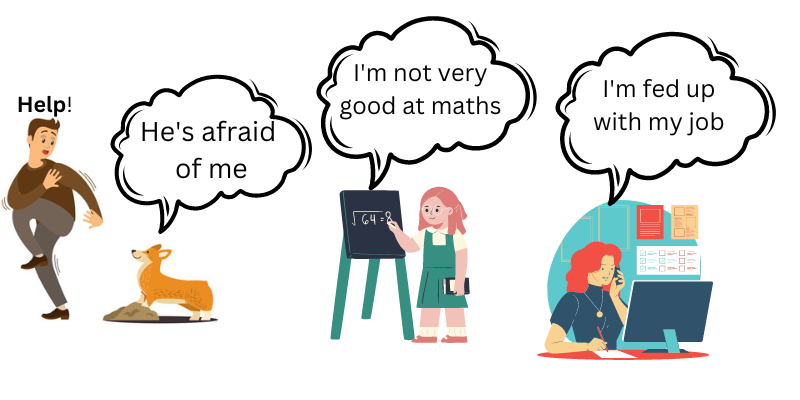
afraid of .... good at etc. of/at/for etc (prepositions) + ing
afraid of ... / scared of ... - Are you afraid of dogs? angry with somebody angry about something: - Why are you angry with me? What have I done? - Are you angry about last night? (= something that happened last night).

listen to...., look at... etc (verb + preposition)
speak to somebody (about ... ) thank somebody for ... think about ... or think of ... wait for ... 1. Don't ask me for money. I don't have any. 2. This house doesn't belong to me. (= it's not mine)

put on your shoes / put your shoes on (phrasal verbs 2)
Sometimes a phrasal verb (put on / take off etc.) has an object. For example: - It was cold, so I put on my coat or I put my coat on. - take them off (not take off them). - I'm going to take off my shoes or take my shoes off. - Here's your coat. Put it on. - Your shoes are dirty. Take them off.