have and have got:
I have (something) or I've got (something) = it is mine:
° I have a new car. or I've got a new car.
° Sue has long hair. or Sue has got long hair.
° Do they have any children? or Have they got any children?
° Tom doesn't have a job. or Tom hasn't got a job.
° How much time do you have? or How much time have you got?
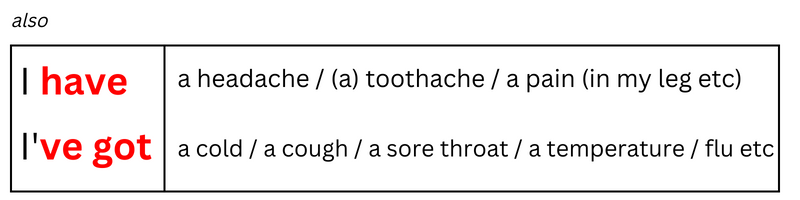
° I have a headache. or I've got a headache.
° Do you have a cold? or Have you got a cold?
The past is I had (without got) / I didn't have / Did you have? etc. :
° When I first met Sue, she had short hair.
° He didn't have any money because he didn't have a job.
° Did you have enough time to do everything you wanted?
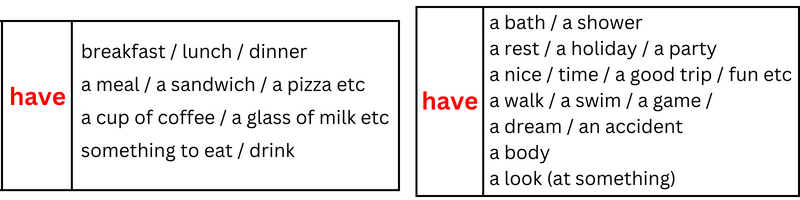
have breakfast / have a shower etc.
In these expressions have = eat/drink/take etc. You can't use
° Where's Lisa? She's having lunch.
° I don't usually have breakfast.
° I had three cups of coffee this morning.
° Have a biscuit! Oh, thank you.
° I had a shower this morning.
° We're having a party next week. You must come.
° Enjoy your holiday. Have a nice time!
° Did you have a good time in Tokyo?
° Sandra has just had a baby.
° Can I have a look at your magazine?
Compare:
Have or have got
° I have / I've got a new shower. It's very good. Have (not have got)
° I have a shower every morning. (not I've got a shower every morning)
° A: Where's Paul?
B: He's having a shower. (= he's washing now)
Make sentences form of have or have got.
1. I didn't have time to do the shopping yesterday.
2. Has Lisa got (OR Does Lisa have.) a car? No, she can't drive.
3. He can't open the door. He doesn't have / He hasn't got a key.
4. Gary had a cold last week. He's better now.
5. What's wrong? Do you have / Have you got a headache?
6. We wanted to go by taxi, but we didn't have enough money.
7. Laura is very busy. She doesn't have / She hasn't got much free time.
8. Did you have any problems when you were on holiday?
Another example:
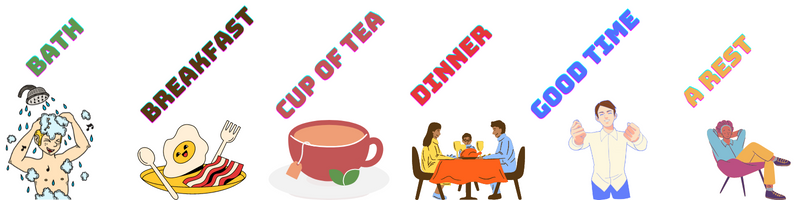
1. They're having breakfast.
2. She's/She is having a cup of tea.
3. He's/He is having a rest.
4. They're/They are having a good time.
5. They're/They are having dinner.
6. He's/He is having a bath.
What do you say in these situations? Use have.
1. Emily is going on holiday. What do you say to her before she goes? Have a nice holiday!
2. You meet Clare at the airport. She has just got off her plane. Ask her about the flight. Did you have a good flight?
3. Tom is going on a long trip. What do you say to him before he leaves? Have a nice/good trip!
4. It's Monday morning. You are at work. Ask Paula about her weekend. Did you have a nice/good weekend?
5. Paul has just come home after playing tennis with a friend. Ask him about the game. Did you have a nice/good game (of tennis)?
6. Rachel is going out this evening. What do you say to her before she goes? Have a nice/good time! or Have a nice/good evening! or Have fun!
7. Mark has just returned from holiday. Ask him about his holiday. Did you have a nice/good holiday?
Make the sentences. Use have/had.
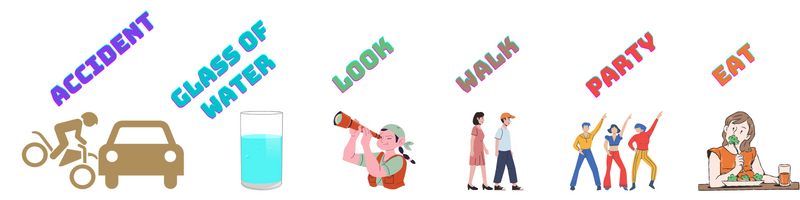
1. We had a party a few weeks ago. We invited 50 people.
2. Shall we have something to eat? No, I'm not hungry!
3. I was thirsty, so I had a glass of water.
4. I like to get up early and have a walk before breakfast.
5. Tina is a very good driver. She has never had an accident.
6. There's something wrong with the engine of my car. Can you have a look at it.