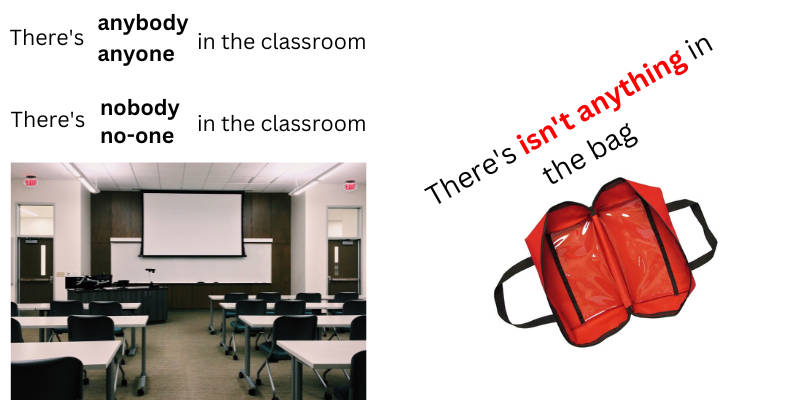
not + anybody/anyone/nobody/no-one (for people)
- There's anybody in the room.
- There's nobody in the room.
- A: Who is in the room?
B: Nobody / no-one.
- body and -one are the same anybody = anyone nobody = no-one:
not + anything nothing (for things):
- There's isn't anything in the beg.
- There is nothing in the beg.
- A: What's in the bag?
B: Nothing.
not + anybody/anyone
- I don't know anybody (or anyone) here.
nobody = not + anybody no-one = not + anything:
- I'm lonely. I have nobody to talk to. (= I don't have anybody).
- The house is empty. There is no-one in it. (= There's isn't anyone in it).
not + anything:
- I can't remember anything.
nothing = not + anything:
- She said nothing. (= She didn't say anything).
- There's nothing to eat. (= There isn't anything to eat).
You can use nobody/no-one/nothing at the beginning of a sentence or alone (to answer a question):
- The house is empty. Nobody lives there.
- Who did you speak to? No-one.
- Nothing happened
- What did you say? Nothing.
remember negative verb + anybody/anyone/anything:
positive + nobody/no-one/nothing:
- He doesn't know anything (not He doesn't know nothing)
- Don't tell anybody (not Don't tell nobody)
- There is nothing to do in this town. (= not There isn't nothing)
Make these sentences again with nobody/no-one or nothing.
1. There isn't anything in the bag. There's nothing in the bag.
2. There isn't anybody in the office. There's nobody in the office.
3. I don't have anything to do. I have nothing to do. / I've got nothing to do.
4. There isn't anything on TV. There's nothing on TV.
5. There wasn't anyone at home. There was no-one at home.
6. We didn't find anything. We found nothing.
Make these sentences again with anybody/anyone or anything.
1. There's nothing in the bag. There isn't anything in the bag.
2. There was nobody on the bus. There wasn't anybody on bus.
3. I have nothing to read. I don't have anything to read.
4. I have no-one to help me. I haven't got anything to help me.
5. She heard nothing. She didn't hear anything.
6. We have nothing for dinner. We don't have anything for dinner. / We haven't got anything for dinner.
Answer these questions with nobody/no-one or nothing.
1a What did you say? Nothing.
2a Who saw you? Nobody.
3a What do you want? Nothing
4a Who did you meet? Nobody./No-one.
5a Who knows the answer? Nobody./No-one.
6a What did you buy? Nothing.
7a What happened? Nothing.
8a Who was late? Nobody./No-one.
Now answer the same questions with full sentences.
Use nobody/no-one/nothing or anybody/anyone/anything:
1b I didn't say anything.
2b Nobody saw me.
3b l don't want anything.
4b
l didn't meet anybody/ anyone.
5b Nobody/No-one knows the answer.
6b
l didn't buy anything.
7b
Nothing happened.
8b Nobody/No-one was late.
Make the sentences. Use: nobody / no-one / nothing or anybody / anyone / anything
1. That house is empty. Nobody lives there.
2. Jack has a bad memory. He can't remember anything.
3. Be quiet! Don't say anything.
4. I didn't know about the meeting. Nobody/No-one told me.
5. What did you have to eat? Nothing I wasn't hungry.
6. I didn't eat anything I wasn't hungry.
7. Helen was sitting alone. She wasn't with anybody/anyone.
8. I’m afraid I can't help you. There's nothing I can do.
9. I don't know anything about car engines.
10. The museum is a free. It doesn't cost anything to go in
11. I heard a knock on the door, but when I opened it, there was nobody/no-one there.
12. The hotel receptionist spoke very fast. I didn't understand anything.
13. What are you doing tonight? Nothing Why?
14. Sophie has gone away Nobody/No-one knows where she is. She didn’t tell anybody/anyone where she was going.