afraid of / good at ... etc (adjective + preposition):
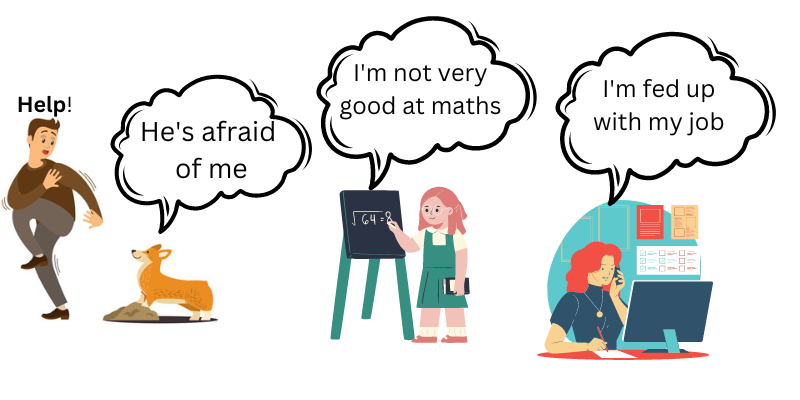
afraid of ... / scared of ...
- Are you afraid of dogs?
angry with somebody angry about something:
- Why are you angry with me? What have I done?
- Are you angry about last night? (= something that happened last night).
different from ... or different to ... fed up with ...
- I’m fed up with my job. I want to do something different. (= I've had enough of my job).
- The room was full of people.
- Lisa is very different from (or to) her sister.
full of ... good at ... interested in ... married to ...
- Are you good at maths?
- I'm not interested in sport.
- Sue is married to a dentist. (= her husband is a dentist).
nice/kind of somebody to ... be nice/kind to somebody..
- It was kind of you to help us. Thank you very much.
- David is very friendly. He's always very nice to me.
sorry about a situation sorry for/about doing something be/feel sorry for somebody:
- I’m afraid I can't help you. I'm sorry about that.
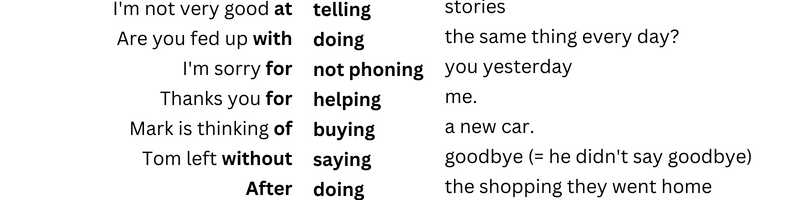
- I'm sorry for/about not phoning you yesterday. (or I'm sorry I didn't phone you).
- I feel sorry for them. They are in a very difficult situation.
of/at/for (etc) + ing:
Make the sentences with in/to/with/at/of etc:
1. He's afraid of dogs.
2. She's interested in science.
3. She's married to a footballer.
4. She's very good at languages.
5. He's fed up with the weather.
6. A: Can I help you?
B: Thanks, that's very kind of you.
Make the sentences with in/of/with etc:
1. I’m not interested in sport.
2. I'm not very good at sport.
3. I like Sarah. She's always very kind to me.
4. I'm sorry about your broken window. It was an accident.
5. He's very brave. He isn't scared of anything.
6. It was very nice of Jane to let us stay in her apartment.
7. Life today is very different from life 50 years ago.
8. Are you interested in politics?
9. I feel sorry for her, but I can't help her.
10. Chris was angry about what happened.
11. These boxes are very heavy. They are full of books.
12. I'm sorry for getting angry with you yesterday.
Another example:
1. I’m not very good at telling stories. (good/tell).
2. I wanted to go to the cinema, but Paula wasn't interested in going (interested/go).
3. Sue isn't very good at getting up in the morning. (good/get).
4. Let's go! I'm fed up with waiting (fed up / wait).
5. I’m sorry for/about waking you up in the middle of the night. (sorry/wake).
6. Sorry I'm late! Thank you for waiting (thank you / wait).
Make the sentences. Use without -ing:
1. (Tom left / he didn't say goodbye) Tom left without saying goodbye.
2. (Sue walked past me / she didn't speak) Sue walked past me without speaking.
3. (Don't do anything / ask me first) Don't do anything without asking me first.
4. (I went out / I didn't lock the door). I went out without locking the door.
Make sentences about yourself:
1. I’m interested in sport (interested).
2. I'm scared of the dark. (scared).
3. I'm not very good at drawing. (not very good).
4. I'm not interested in cars. (not interested).
5. I'm fed up with living here. (fed up).