Verb + object:
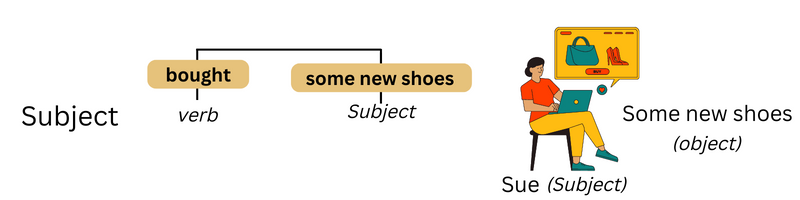
The verb (bought) and the object (some new shoes) are usually together. We say.
- Sue bought some new shoes yesterday.
(not Sue bought yesterday some new shoes).
Verb + object:
- He speaks - English very well. (not He speaks very well English).
- I like - Italian food very much. (not I like very much ... ).
- Did you watch - TV all evening? (not ... watch all evening TV).
- Paul often wears - a black hat. (not Paul wears often ... ).
- We invited - a lot of people to the party.
- I opened - the door slowly.
- Why do you always make - the same mistake?
- I'm going to borrow - some money from a friend.
Where and when:
Place (where?) is usually before time (when?). We say:
- We went to a party last night. (not We went last night to a party).
place (where?) + (when? how long? how often?):
- Lisa walks - to work every day. (not ... every day to work).
- Will you be - at home this evening? (not ... this evening at home).
- I usually go - to bed early. (not ... early to bed).
- We arrived - at the airport at 7 o'clock.
- They've lived - in the same house for 20 years.
- Joe's father has been - in hospital since June.
Make the sentences Right or wrong ?:
1. Did you watch all evening TV? Did you watch TV all evening?
2. Sue bought some new shoes yesterday. OK.
3. I like very much this picture. I like this picture very much.
4. Tom started last week his new job. Tom started his new job last week.
5. I want to speak English fluently. OK.
6. Jessica bought for her friend a present. Jessica bought a present for her friend.
7. I drink every day three cups of coffee. I drink three cups of coffee every day.
8. Don't eat your dinner too quickly! OK.
9. I borrowed from my brother fifty pounds. I borrowed fifty pounds from my brother.
Put the words in order.
1. (the door / opened / I / slowly) - I opened the door slowly.
2. (a new phone / I / last week / got)- I got a new phone last week.
3. (finished / Paul / quickly / his work) - Paul finished his work quickly.
4. (Emily / very well / French / doesn't speak) - Emily doesn't speak French very well.
5. (a lot of shopping / did / 1 / yesterday) - I did a lot of shopping yesterday.
6. (London / do you know / well?) - Do you know London well?
7. (we / enjoyed / very much / the party) We enjoyed the party very
8. (the problem / carefully / I / explained) I explained the problem carefully.
9. (we / at the airport / some friends / met) We met some friends at the airport.
10. (did you buy / in England / that jacket?) - Did you buy that jacket in England?
11. (every day / do / the same thing / we) - We do the same thing every day.
12. (football / don't like / very much/1) - I don't like football very much.
Put the words in order:
1. (to work / every day / walks / Lisa) = Lisa walks to work every day.
2. (at the hotel / I / early / arrived) = I arrived at the hotel early.
3. (goes / every year / to Italy / Julia) = Julia goes to Italy every year.
4. (we / since 1998 / here / have lived) = We have lived here since 1998.
5. (in London / Sue / in 1990 / was born) = Sue was born in London in 1990.
6. (didn't go / yesterday / Paul / to work) = Paul didn't go to work yesterday.
7. (to a wedding / last weekend / went / Helen) = Helen went to a wedding last weekend.
8. (1 / in bed / this morning / my breakfast / had) = I had my breakfast in bed this morning.
9. (in September / Amy / to university / is going) = Amy is going to university in September.
10. (1 / a beautiful bird / this morning / in the garden / saw) = I saw a beautiful bird in the garden this morning.
11. (many times / have been / my parents / to the United States) = My parents have been to the United States many times.
12. (my My umbrella / I / last night / left / in the restaurant) = I left my umbrella in the restaurant last night.
13. (to the cinema / tomorrow evening / are you going?) = Are you going to the cinema tomorrow evening?
14. (the Are children / 1 / took / this morning / to school) = I took the children to school this morning.


 The verb (bought) and the object (some new shoes) are usually together. We say.